

TL;DR
- A clear interview schedule template helps keep interviews on track.
- Use a structured interview itinerary template for smooth candidate flow.
- Free interview schedule templates in Word, form, and table formats.
- A good agenda reduces confusion and improves candidate experience.
- Avoid common mistakes such as poor timing and an unclear interview agenda.
Finding the right talent is tough enough, but coordinating interviews without a clear interview schedule template can turn hiring into chaos. Hiring teams waste hours confirming times, candidates miss emails, and interviews start late.
A simple, ready-to-use solution changes everything. This blog gives you ready to use interview schedule templates, including interview schedule template Word files and simple forms that fit easily into your hiring process. You will also see why interview scheduling plays a bigger role than most teams realize and how small changes can keep candidates and interviewers on the same page.
What Is an Interview Schedule Template?
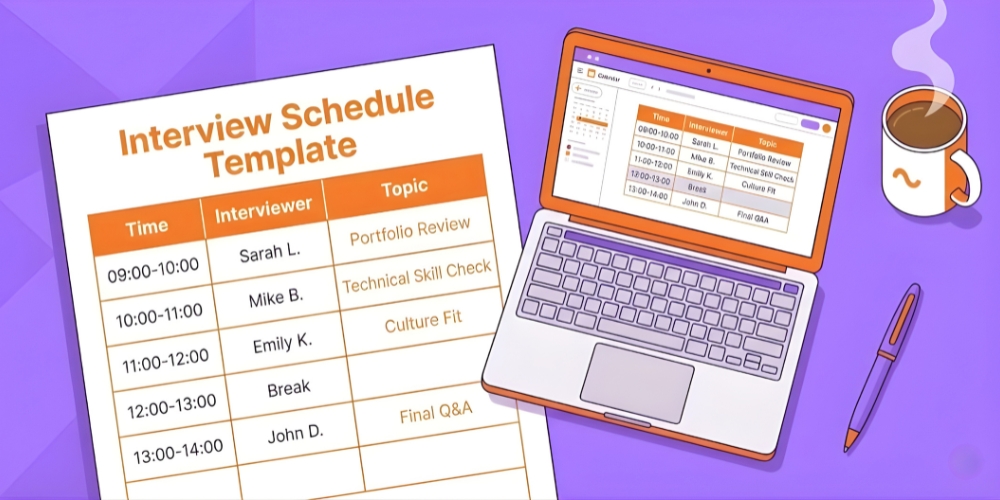
An interview schedule template is a preformatted document that outlines the timeline, participants, and activities for an interview day or session. It provides structure so hiring teams and candidates know exactly what to expect.
Templates can come in various shapes, like:
- A format for interview schedule in table form.
- A downloadable interview schedule form with fields to fill.
- A classic interview itinerary template that shows time slots and locations.
Using a clear template means hiring managers spend less time creating schedules from scratch and more time making informed decisions. When you start with something designed for clarity then everyone benefits.
Build Your Interview Schedule
Drag the blocks into the correct order. Make it read cleanly for a candidate.
Step 1 Drag these blocks
Interview start time
Example 10:00 AM
Interviewer
Name and role
Interview type
Phone, panel, task
Location or link
Room or meeting link
Notes
What to bring, prep
Step 2 Drop into order
First
1Second
2Third
3Fourth
4Fifth
5Tip: A good schedule answers the who, what, when, and where.
Why Interview Scheduling Matters More Than You Think
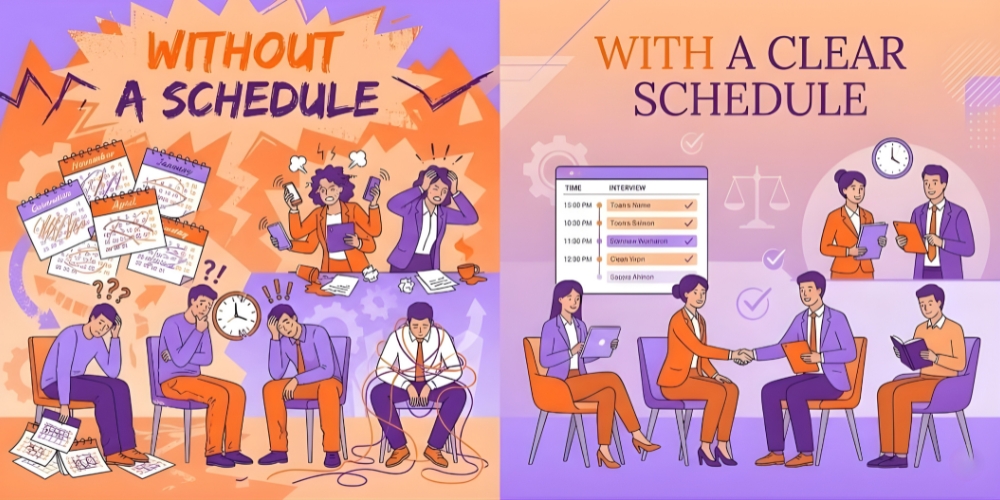
Interview scheduling is more than booking rooms or setting times. It reflects how organized your company is. A well-planned schedule gives candidates confidence and keeps internal teams synchronized. Why does this matter in today’s hiring environment?
Efficiency Saves Money
Unstructured scheduling leads to reschedules, extra emails and long gaps that drag the whole process out. According to a 2025 recruiting industry survey, 35% of recruiters’ time is spent on interview scheduling, making it one of the most time-consuming parts of hiring and a likely source of delays if not managed well.
Candidate Experience Drives Decisions
Candidates judge your company long before an offer. Scheduling is one of the first real experiences they have. Clear schedules signal respect for a candidate’s time and strongly shape how they view the hiring process. The 2025 Candidate Experience Report found that 66% of candidates said a good hiring experience influenced whether they chose to move forward with an offer, which highlights how critical the interview stage really is.
Keeps Everyone Aligned
Hiring typically involves multiple people such as recruiters, hiring managers, department leads and sometimes external stakeholders. A solid schedule ensures everyone knows:
- Who is interviewing whom
- When each block starts and ends
- What materials or assessments are needed
Free Interview Schedule Templates (Ready to Use)
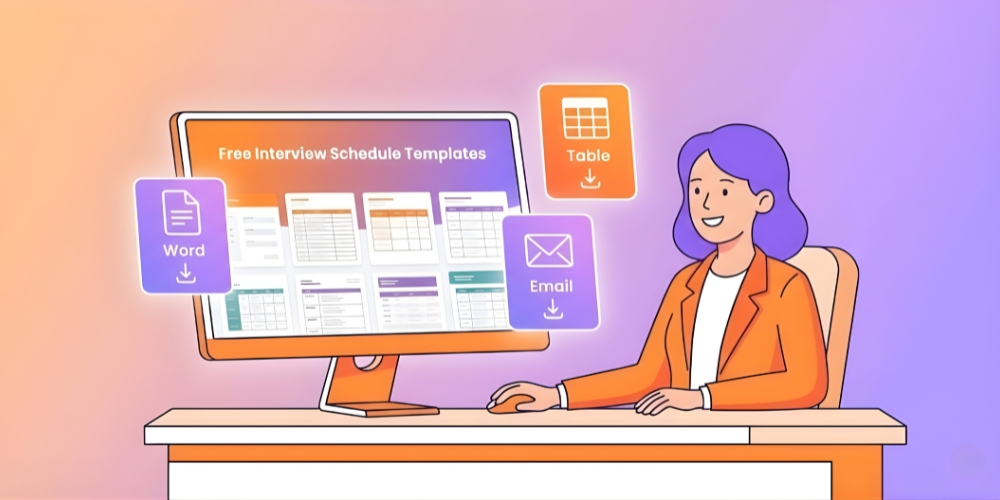
Here are practical templates you can use right now. You can copy these directly into your preferred document editor or hiring system.
Basic Interview Schedule (Simple Table)
Perfect for one-on-one interviews or small panels.
| Time | Interviewer | Candidate Name | Topic/Focus | Notes |
| 09:00 | Jane Doe | John Smith | Intro + Role Fit | Zoom Link |
| 09:30 | Jane Doe | John Smith | Technical Review | Send test |
This template functions as both a format for interview schedule and an interview itinerary template. Use it to keep written records or share with teams.
Full Day Interview Schedule (Word)
Ideal for multiple stage interviews spanning several hours.
This format covers:
- Time blocks
- Breaks
- Panel assignments
- Candidate contact details
It helps coordinate multiple interviewers and ensures no one overlaps or doubles up on questions.
Email-Based Schedule for Candidates
In some cases, a simple and clear message works better than any tool. You can use this schedule for interview email template to share details with candidates.
Subject: Interview Confirmation for [Position Name]
Hello [Candidate Name]
Thank you for interviewing with us. Below is your interview schedule:
[Time] – [Interviewer/Panel] – [Format/Location]
Please arrive 10 minutes early. Bring [Documents/Portfolio].
If you need to reschedule, reply to this message.
Best regards,
[Your Name]
This also doubles as an email template for scheduling an interview, so hiring teams stay consistent.
Assessment-Focused Interview Agenda
For technical roles or candidates with tests and presentations.
| Time | Activity | Owner | Materials |
| 10:00 | Coding Test | Team Lead | Laptop/Software |
| 11:30 | Discussion | Hiring Manager | Feedback Sheet |
This also works as a clear interview agenda that lays out both skill based assessments and face to face conversations in one place.
Multi-Location Interview Form
Great for interviews in different physical spaces. Create a simple interview schedule form that tracks room assignments and candidate movement between locations.
| Room | Time | Candidate | Interviewer | Notes |
This helps reduce confusion and keeps facilities teams informed.
Template Finder Quiz
Answer 3 quick questions. You will get the best interview schedule template type for your situation.
How many interviewers are involved?
Question 1Is the interview remote or on site?
Question 2How long is the process?
Question 3Pick one option in each question.
Recommendation Your best template type
Tips to Customize Interview Schedules Effectively
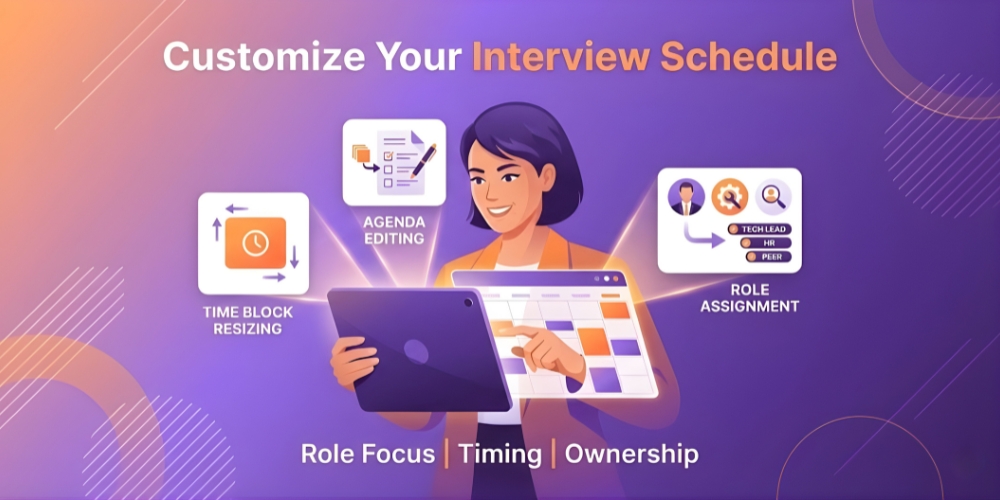
A free template is a strong start. Customizing it to your role and team makes it actually work.
Start by matching the agenda for the interview to the job level. Entry-level roles need shorter sessions focused on skills and culture. Senior roles need deeper discussions and more interviewer time. Avoid one-size-fits-all schedules.
Next, clearly define each part of the interview. State the purpose of every session such as reviewing experience, solving problems or checking team fit.
Add small breaks between interviews. A few extra minutes help people stay sharp and stop the schedule from drifting.
Pick one person to own the schedule. When changes come from one source then mix ups are easier to avoid.
Schedule Stress Test
Move the sliders to match your interview day. The tool gives a quick risk rating for burnout and candidate fatigue.
Inputs Your interview day setup
Shorter interviews can be faster but may miss depth. Longer interviews need more breaks.
Breaks reduce late starts and give candidates time to reset.
More interviewers can improve coverage but increases coordination effort.
Higher volume can cause rushed conversations and more reschedules.
Result Your risk rating
Your setup looks manageable. Add a little buffer if you see frequent late starts.
Common Interview Scheduling Mistakes
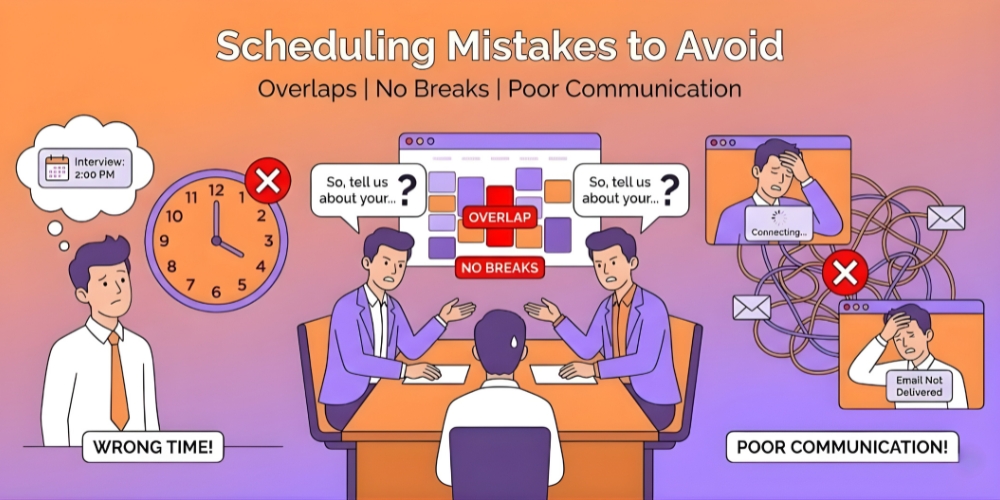
Even experienced hiring teams fall into these traps.
A big mistake is packing the day too tight. Back to back interviews leave no room to think. Interviewers rush. Candidates feel drained. The conversation suffers.
Another problem is unclear messaging. A calendar invite alone does not explain what will happen. When candidates know the plan ahead of time, confusion and last minute questions drop.
Time zones also cause trouble in remote hiring. Even a small time difference can lead to missed calls and frustration on both sides.
Some teams miss alignment. Interviewers end up asking the same questions because no one guides the flow. A simple plan keeps interviews fair and on track.
Spot the Mistake Puzzle
Find 5 hidden scheduling mistakes in the sample plan below. Click the small buttons inside the schedule. Each click unlocks a clue on the right.
Sample schedule Something is off here
| Time | Session | Interviewer | Location | Find |
|---|---|---|---|---|
| 09:00 | Intro call | Sarah | Zoom | |
| 09:30 | Hiring manager chat | Ali | Zoom | |
| 10:00 | Technical interview | Ali | Zoom | |
| 10:00 | Culture interview | Nina | Room 4B | |
| 10:30 | Task brief | Panel | TBD | |
| 11:00 | Task brief | Panel | Room 4B |
Start clicking the question marks. Try to solve without guessing.
No breaks Locked
Add buffer time. Late starts spread fast and candidates feel rushed.
Overlapping interviewer Locked
The same interviewer cannot be in two sessions at the same time.
Missing location detail Locked
Do not leave location vague. “TBD” is not a plan.
Duplicate round Locked
Two identical sessions confuse the team and the candidate.
Time zone mismatch Locked
One session looks remote, another looks on site. Confirm the time zone and format.
How AI Improves Interview Scheduling
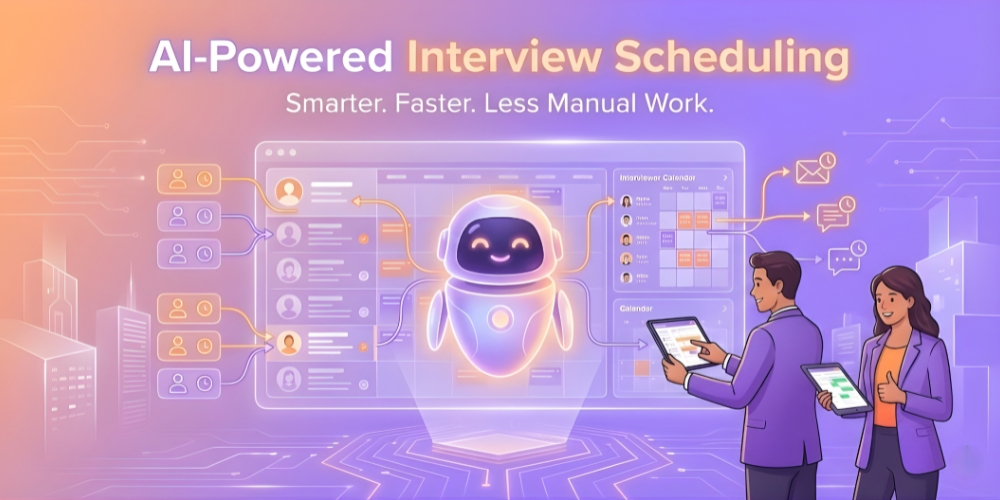
Hiring teams today handle more candidates with fewer resources. This is where AI recruitment tools quietly make a difference.
AI-powered scheduling tools can automatically match interviewer availability with candidate preferences. This reduces back-and-forth email and speeds up hiring cycles.
AI also helps flag conflicts, manage reschedules and send reminders without manual effort. In companies that use AI for job interviews, scheduling is often integrated with assessments and video interviews which creates a smoother flow.
When paired with pre-employment screening, AI tools help make sure only qualified candidates reach interviews. This cuts down on wasted time and keeps interviewers from burning out.
Manual vs AI Timeline Race
Hit start. Watch both timelines move. One side drifts into waiting and follow ups. The other stays tight.
Click Start race. Then see if you can spot what slowed the manual timeline.
Manual scheduling The slow lane
00:00AI assisted scheduling The fast lane
00:00Interview Scheduling for Candidate Experience

Candidates get a glimpse into your company long before you even extend an offer and that very first real interaction is often that initial interview – more specifically, the scheduling process that gets them there.
Having a clear plan shows that you actually value people’s time, and when a candidate knows exactly when and who they’re heading into an interview with, a weight lifts off their shoulders and their confidence gets a welcome boost. They get a sense of who they’re meeting & what to expect.
Transparency also builds trust. A structured interview schedule template signals professionalism and fairness. It tells candidates your company values clarity.
Flexibility matters too. Allowing candidates to choose from available slots improves response rates and reduces dropouts.
Candidate Mood Tracker
Click each stage to see how the candidate mood changes. Switch between clear and confusing schedules. One of the stages is a trap. It looks harmless but it hits mood the hardest.
Journey Click a stage
Interview invite received
A clear invite tells candidates what to expect. It lowers nerves and cuts back and forth.
Timing is clear, the format is stated, and the candidate can prepare.
Conclusion
Interview scheduling is a whole lot more than just some admin tasks as it actually sets the tone for the rest of your hiring process. Having a good template, direct communication and using technology in the right way can get your teams moving without sacrificing quality.
When done right, those interviews start feeling a bit more like focused conversations and less like this stressful shopping list you’re trying to tick off. Start with a solid template, tailor it to the job at hand and make scheduling a priority in your hiring process.
FAQs
Quick answers to common interview scheduling questions.