

TL;DR
- Hiring for culture sounds safe but quietly blocks fresh thinking.
- Teams that hire the same type of people miss better ideas.
- Cultural fit hiring increases bias even when intentions are good.
- High-performing teams focus on skills, values and growth instead.
- Shifting the hiring lens leads to stronger and more balanced teams.
Many teams still rely on hiring for culture as a shortcut. It feels right to choose people who talk the same, act the same and seem easy to work with. Over time, this creates teams that look aligned on the surface but struggle with blind spots, slow decisions and group thinking. The problem is not bad intent. The problem is that cultural fit is vague and open to bias.
There is a better way forward. Companies that focus on skills, values and what a person adds instead of who they resemble build teams that adapt faster, perform better and stay fair. This blog will break down why cultural fit fails and what to do instead.
What Does Hiring for Culture Really Mean?
Ask ten hiring managers what is culture fit and you will hear ten different answers. For some, it means shared values. For others, it means personality. In many cases, it quietly turns into comfort. Someone feels familiar, so they feel right.
This is where confusion starts. Culture becomes mixed up with hobbies, tone of voice or background. Some teams even describe it as hiring employees who fit your team’s vibe and culture. That may sound harmless but it pushes hiring away from ability and toward similarity.
A study of 42 firms found that 74% of employers hire based on cultural fit. The research shows this can become a subjective filter where candidates are rejected for reasons unrelated to skill. When hiring relies on instinct, managers often choose people who feel familiar and pass over those who do not.
Define the Fit Radar
Move the sliders. Watch how your definition of “fit” changes.
Tip: If “Personality match” or “Background similarity” dominates, you are drifting into gut-feel hiring.
Why Hiring for Culture Is a Problem
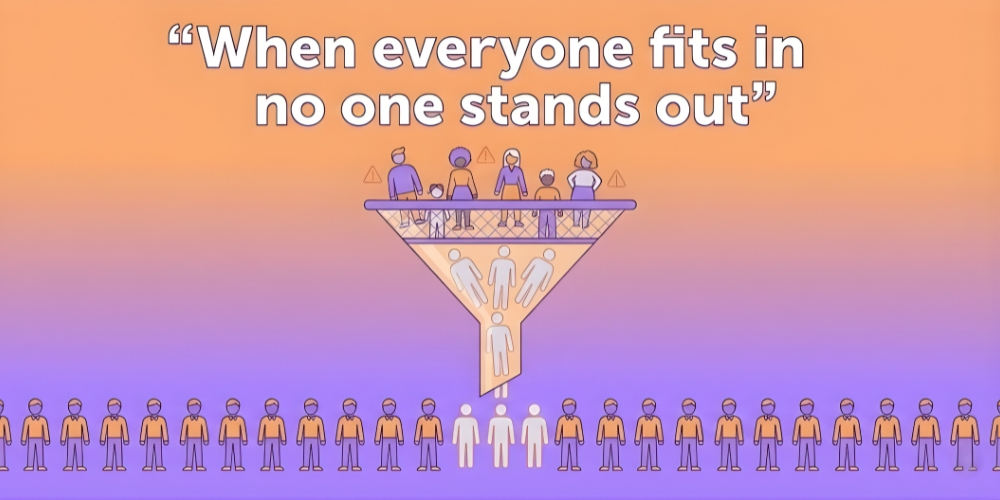
Hiring for culture limits growth
Teams built on sameness struggle when markets change. New ideas rarely come from people who think the same way. McKinsey research found a clear gap in results. Companies with diverse teams were found to be 36% more likely to post stronger profits than those with little diversity. This gap shows how leadership shaped by sameness can quietly hold performance back over time.
Hiring for organizational fit gets misused
Many teams say they hire for organizational fit but fail to define what that means. Instead of shared values, it becomes shared habits. Instead of principles, it becomes a preference. This blurs the line between alignment and exclusion.
Pop culture fit is not real culture
Some companies confuse workplace culture with jokes, music or social rituals. This idea of pop culture fit has nothing to do with performance or ethics. It only measures how comfortable someone feels in the room on day one.
Hiring Funnel Simulator
Click through the steps to see how vague “fit” filters can shrink your candidate pool before skills are even considered.
Choose the first filter. This is where many teams accidentally remove strong people.
How the interview is run often decides whether bias has room to sneak in.
This is the moment many teams turn values into preferences.
The last step shows how one vague opinion can outweigh strong proof.
Quick check: If “fit” filters happen before skills, you may lose strong candidates before you can evaluate them fairly.
How Hiring for Culture Reinforces Bias
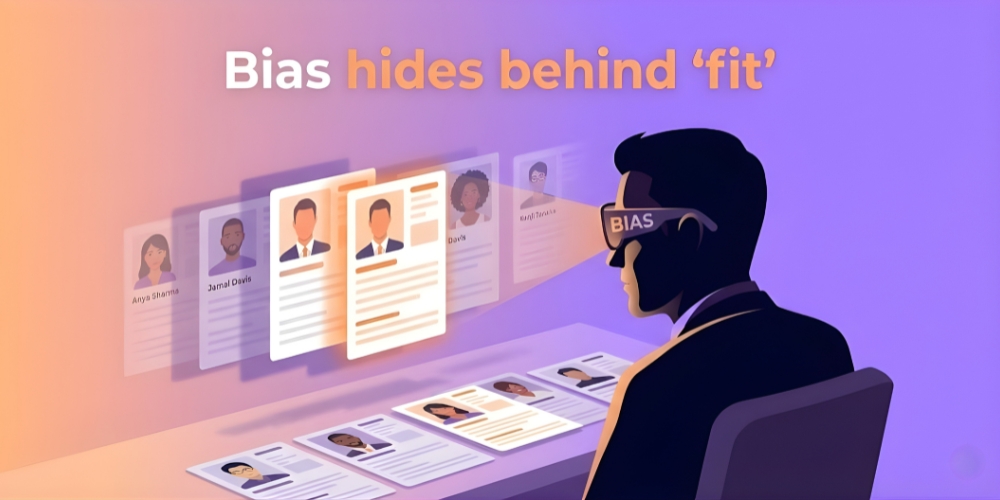
Bias hides behind good intentions
Bias in hiring is rarely deliberate. Cultural fit often hides it in plain sight. When a candidate is labeled as not a fit, then the decision is difficult to challenge because the standard is vague and undefined.
Culture and talent get separated
When teams focus on comfort, they trade off ability. This weakens the link between culture and talent. High-skilled candidates who think differently get filtered out early.
Tools can scale the problem
Some companies use AI screening for culture fit or AI assisted cognitive testing without strong guardrails. When training data reflects past biased hiring practices, then these tools reproduce the same patterns more quickly.
Bias Spotting Mini-Game
Read each comment. Decide if it is a clear hiring signal or a biased “fit” shortcut.
“Did not feel like a culture fit.”
“Communication style felt off.”
“Would not grab coffee with the team.”
“Missed two required questions and could not explain the steps.”
“Could not give a real example of handling conflict with a teammate.”
“Not the kind of person we usually hire.”
The Real Cost of Hiring for Culture
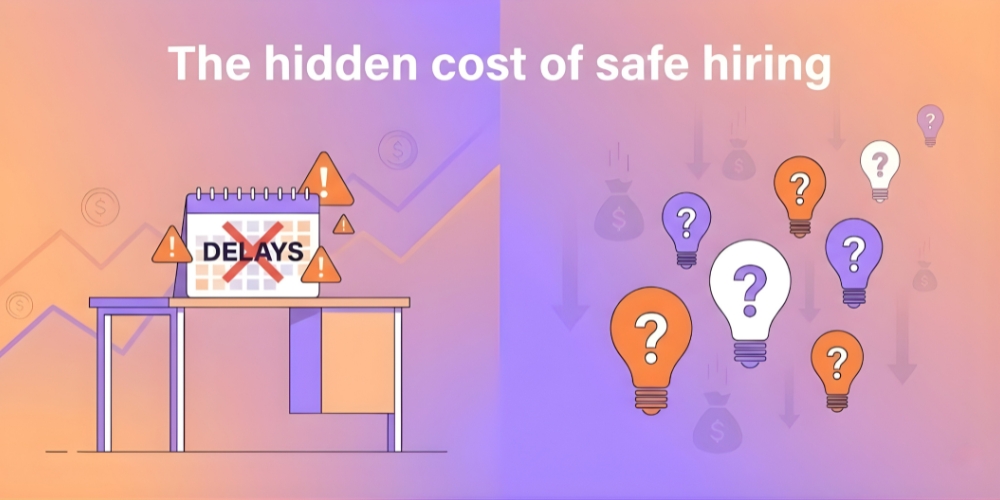
The highest cost of hiring for culture does not show up right away. It appears slowly in missed ideas, slow growth and higher turnover. Teams may feel calm but they stop challenging each other.
Deloitte found a clear link between inclusion and results. Companies that build inclusive cultures are more likely to hit their financial goals. They also tend to perform better overall and create environments where new ideas and change are easier to support.
There is a real financial impact as well. When candidates are turned away for unclear fit reasons, positions remain unfilled for longer. Work gets delayed and strong candidates accept offers elsewhere. Over time, this erodes confidence in the hiring process and damages the employer’s reputation.
Cultural fit hiring can create legal and compliance issues over time. When a decision is hard to explain, it is also hard to defend. As hiring becomes more structured and reviewed, unclear judgments draw more scrutiny.
Hidden Cost Calculator
Estimate how “vague fit” rejections can quietly slow work and add cost.
Enter your numbers and hit Calculate.
What to Hire for Instead: Culture Add
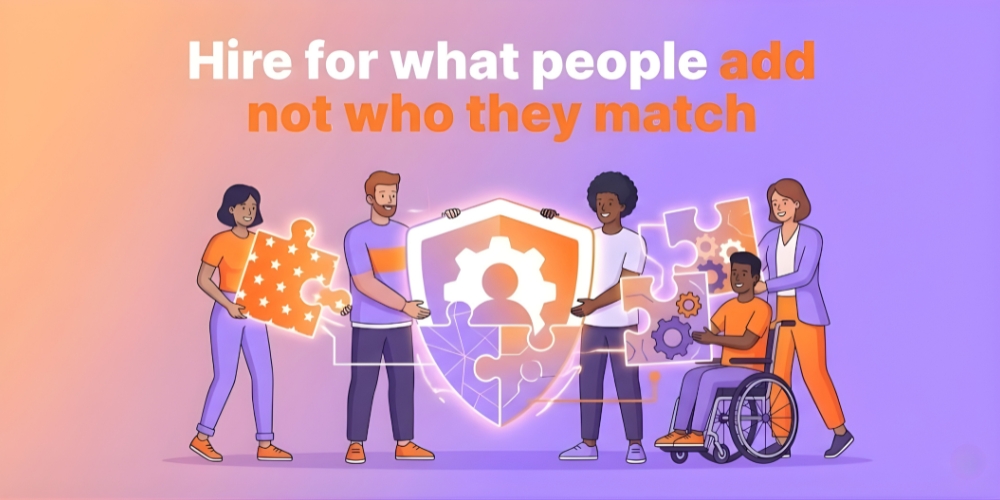
Instead of asking, “Does this person fit in?”, ask what they will bring. Culture add focuses on contribution not similarity. It values people who strengthen shared values while bringing new ideas, skills or experiences.
Culture add does not mean ignoring culture. It means being clear about it. Values like respect, accountability and learning are non-negotiable. Preferences like communication style, humor or background are not.
Teams that hire for culture add become more adaptable. They handle change better because they already contain different viewpoints. This makes collaboration stronger, not weaker.
When culture is treated as something that grows rather than something to protect, teams stay healthy over time.
Culture Add Evidence Board
Click each value to see what it looks like in real work.
Value Curiosity
Value Ownership
Value Candor
Value Learning
Value Empathy
Value Quality
How to Shift From Cultural Fit to Culture Add
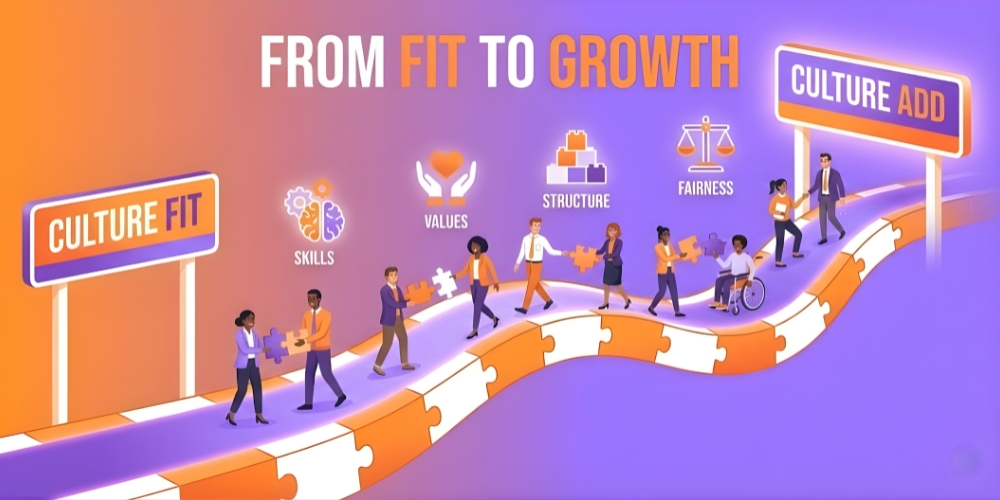
Begin by clearly defining your real values. Skip the slogans and focus on the behaviors you expect from every employee. These should then guide how interviews are run and how candidates are assessed.
Then update the questions you ask. Instead of relying on vague impressions like whether someone feels easy to work with, focus on real situations they may face and how they would handle them.
Bring structure into scoring. When interviewers use the same criteria, then decisions become more consistent and personal bias has less room to creep in.
Take a close look at any tools involved in hiring. Assessments and screening tools should focus on skills and values rather than surface level similarity. Technology should help clarify decisions not make them for you.
Common Objections and Why They Don’t Hold Up
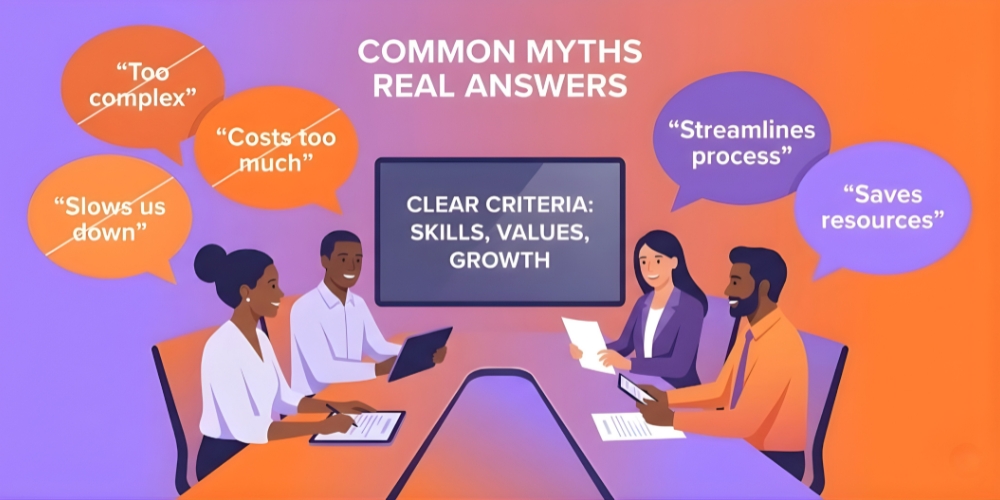
We need people who get along
Respect and professionalism are values, not personality traits. Teams do not need clones to collaborate well.
Culture add will break our team dynamic
Strong cultures evolve. Teams that cannot absorb differences are fragile, not stable.
It is too hard to measure
It is only hard when values are unclear. Once values are defined, then assessment becomes easier.
Cultural fit keeps hiring fast
Fast decisions that lead to turnover slow teams down later. Speed without quality costs more in the long run.
Objection vs Reality Tap-Test
Tap an objection. You will see the reality check instantly.
Unclear decisions slow hiring more than structure does.
A simple scorecard and shared questions reduce back-and-forth. You spend less time debating and more time deciding.
Harmony comes from respect, not sameness.
Teams work well when expectations are clear and behavior stays professional. You do not need clones to collaborate.
Attitude is real, but “vibe” is not a hiring standard.
You can assess reliability, coachability, and ownership with scenarios. You cannot fairly assess “they feel like us.”
You can measure culture through behaviors.
Turn values into observable actions. If you cannot describe it, you cannot assess it. Keep it simple and work-based.
Small teams feel bias faster, not slower.
One vague “not a fit” can block great talent. Early patterns become permanent habits if you do not fix them now.
Conclusion
Cultural fit hiring feels comfortable, but comfort is not a hiring strategy. Teams that want to grow need clarity, courage and structure in how they hire. When companies move away from vague fit decisions and focus on real contribution, they build stronger, fairer, and more capable teams. The shift starts with one question. What will this person add?
FAQs
Quick answers to common questions.